If you’re reading this, then I assume you want your children to be happy.
That’s a good start.
Because not every parent can say that.
The Western world has known the foundations of raising happy children since Aristotle shared his guide to living well more than 2,000 years ago.
It’s called Nicomachean Ethics, and it remains his most important work on how to live a good life.
For parents, two things are clear:
Most of your child’s character is formed in early childhood
Children learn more from what you do than from what you say
If you want your children to live good lives, it begins with being a good example by working on your own character — and it begins now.
Because your parenting shapes the entire arc of your child’s life.
“It makes no small difference, then, whether we form habits of one kind or another from our very youth; it makes a very great difference, or rather all the difference.”
— Nicomachean Ethics, II.1
This essay will show you how…
Why This Matters for Parents
Aristotle makes three things clear:
Character is formed early
Habit shapes destiny
The family is the first school of virtue
This is why Nicomachean Ethics is still studied in elite educational institutions and leadership programmes today.
Most children, however, will never attend elite institutions.
So if you won’t help form your child’s character — who will?
Are you willing to leave it to chance?
Children Learn by Imitation, Not Instruction
Aristotle believed moral lectures are insufficient on their own.
“Arguments and teaching are not powerful with all people. The soul of the student must first be cultivated by habits.”
— Nicomachean Ethics
Translation into plain language:
Children become who they are trained to become via modelling and practice
They do not become who you tell them to be
Modern Research Backs This
Albert Bandura’s Social Learning Theory shows that children learn behaviour primarily through modelling, not explanation.
Longitudinal studies show that:
a child’s self-control mirrors their parent’s
a child’s emotional regulation mirrors their parent’s
a child’s moral reasoning strongly correlates with parental honesty
Neuroscience and developmental psychology now echo Aristotle almost word for word.
The Heckman Curve (James Heckman, Nobel Laureate in Economics) shows that early character formation — self-control, perseverance, and social skills — delivers far higher lifetime returns than later academic intervention.
The Harvard Center on the Developing Child finds that early relational environments shape executive function, emotional regulation, and moral reasoning.
In short: early experiences build brain architecture.
With this in mind, how do we raise children for the good life?
How to Live a Good Life
“Happiness [eudaimonia] is an activity of the soul in accordance with virtue
— Aristotle: Nicomachean Ethics, I.7
In Nicomachean Ethics, Aristotle asks a single central question:
What does it mean to live well as a human being?
First, he is clear that the goal of life is eudaimonia — to flourish as a human being.
Second, as most great philosophers agree, the path to eudaimonia is to live with virtue.
But what does that mean?
What it Means to Live with Virtue
For Aristotle, virtues are human excellences — qualities that allow a person to function at their best, just as sharpness allows a knife to function well.
Examples include:
Courage — facing fear without recklessness
Honesty — telling the truth even when it costs you
Self-control — governing impulses rather than being ruled by them
Justice — treating others fairly
Kindness — caring for others’ good, not just your own
To live with virtue, then, is to live with an excellent and stable character.
It means:
choosing the right action, even when it is difficult
telling the truth when lying would be easier
controlling anger rather than being controlled by it
It means acting each day in a way you would be proud for your children to imitate.
It means living so that:
you can respect yourself
you are worthy of the respect of others
you are worthy of trust
your word means something
your primary concern is doing the right thing, at the right time — especially when it comes at a cost
Virtue is a Balance
Aristotle described virtue as a mean between extremes.
For example:
Courage lies between cowardice and recklessness
Honesty lies between dishonesty and harshness
Generosity lies between stinginess and extravagant waste
Virtue does not deny emotion.
It governs behaviour.
How to Improve Your Character Today
“One swallow does not make a summer, nor does one day; and so too one day, or a short time, does not make a man blessed and happy.”
— Nicomachean Ethics, I.7
This echoes Aristotle’s famous idea that excellence is not a single act, but a habit formed over time.
Character develops as repeated actions take root, gradually reshaping behaviour.
Yet it is also true that any one of us can choose differently today.
Courage practised today is still courage.
Truth told today is still truth.
Generosity shown today matters, even if it is not yet habitual.
What I have found helpful is measuring my daily behaviour against Aristotle’s 12 core virtues.
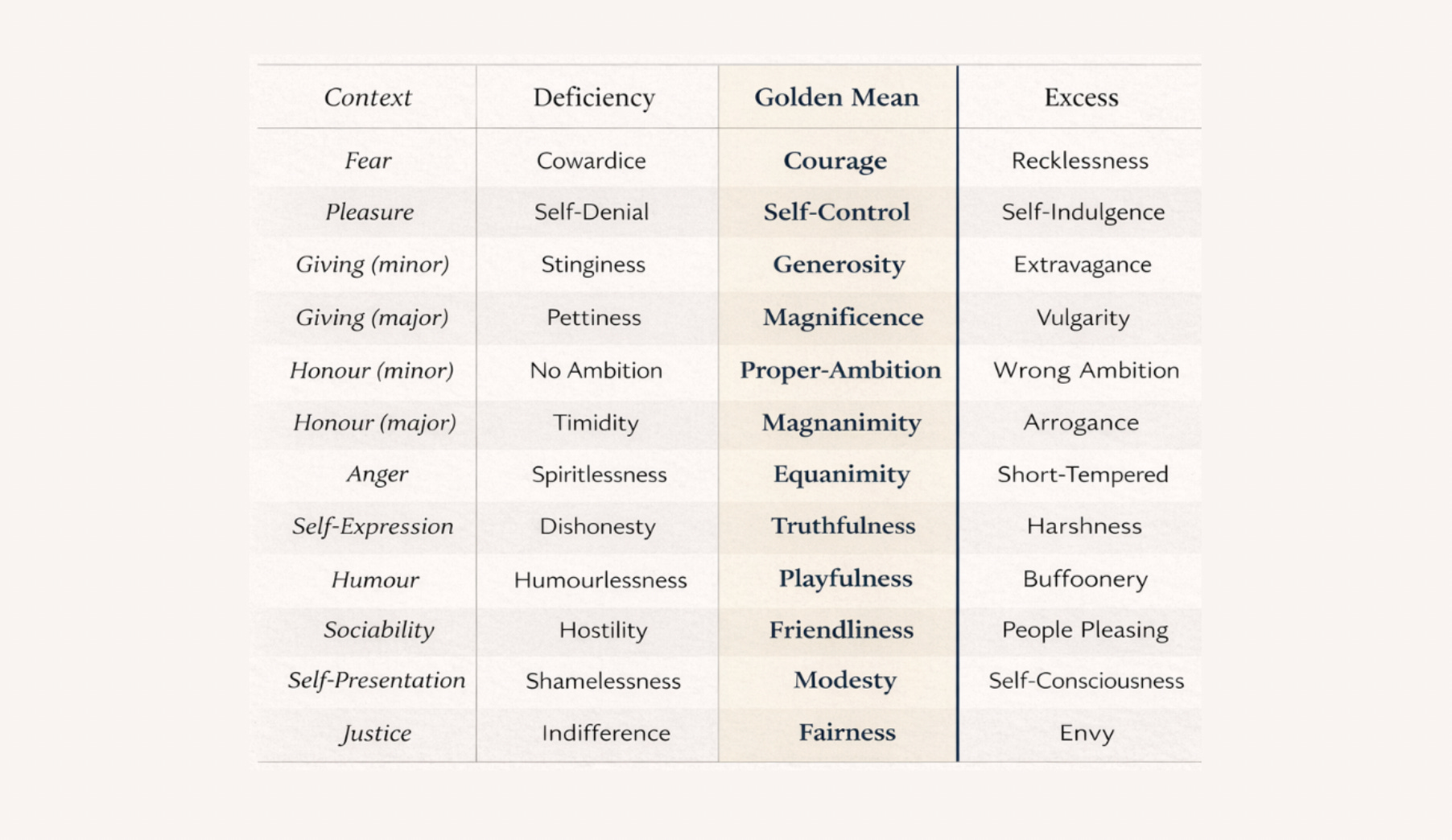
the first column shows the area of life involved
the second and fourth show the opposing vices
the centre shows the virtue as the golden mean
This gives you something fully within your control: your own behaviour.
You can ask:
Was I courageous, cowardly, or reckless today?
Was I honest, evasive, or harsh?
You can measure your child’s behaviour the same way — to check their course, not to judge them.
As with all habit change, this requires daily practice. You may even wish to print the table and keep it visible.
If character is destiny, and your children model their character after you, what more meaningful work could there be than improving yourself — starting today?
Follow us on Instagram and Substack for daily virtue reminders where we remind you of one virtue each morning.
If you liked this virtue essay, sign up to receive our free weekly Virtue Letter on Substack, Spotify, and Youtube.
About Letters For Little Heroes
Created by a former teacher with a masters degree in neuropsychology for childhood education, Letters for Little Heroes helps parents raise children of good character through the timeless power of story.
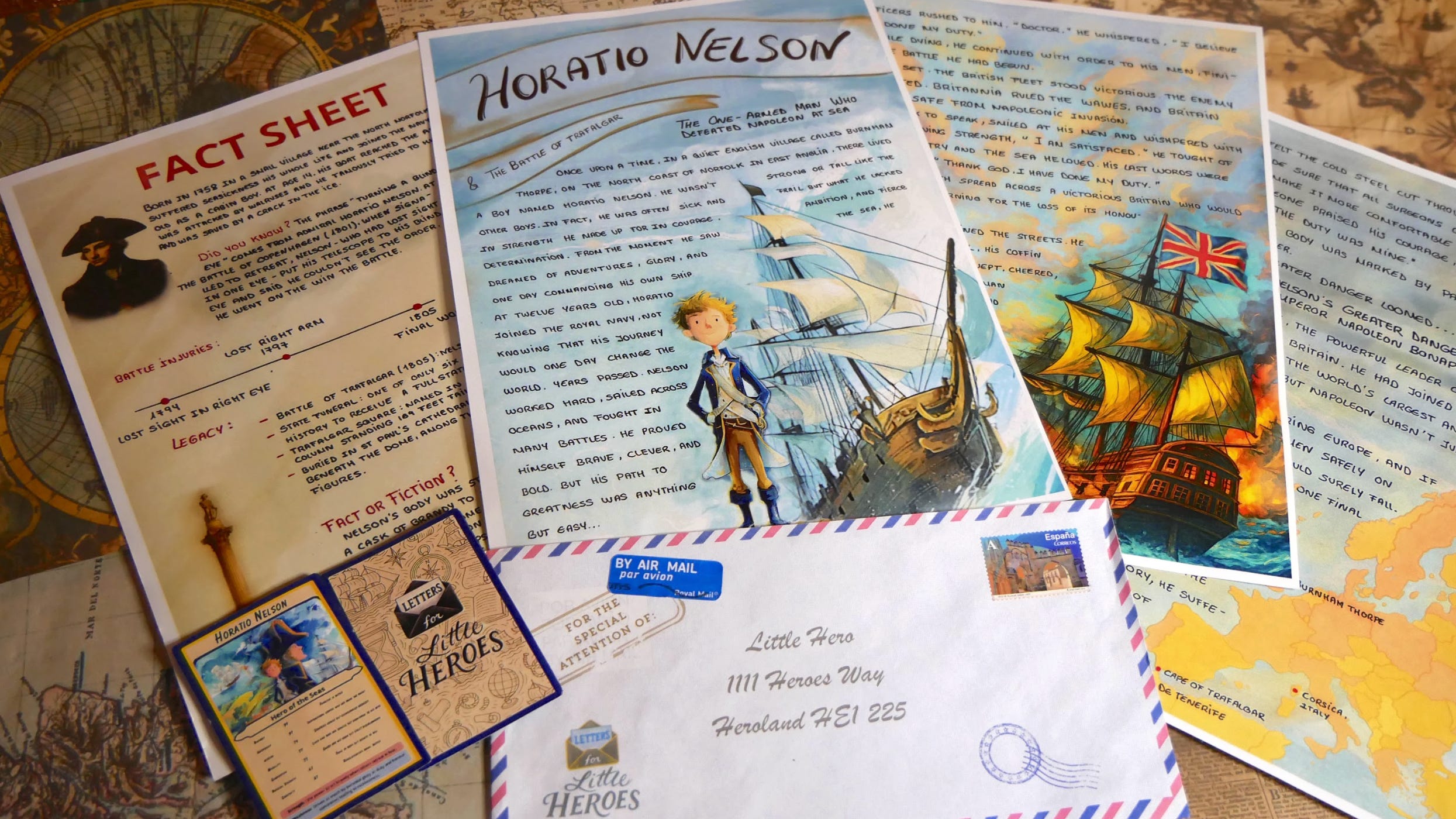
Each month, families receive a beautifully illustrated letter telling the true story of a historical hero — and the virtue they embodied — so children can practise it at home.
Visit our website for more information.
https://lettersforlittleheroes.com/